📌 Editor B's 3-Line Summary
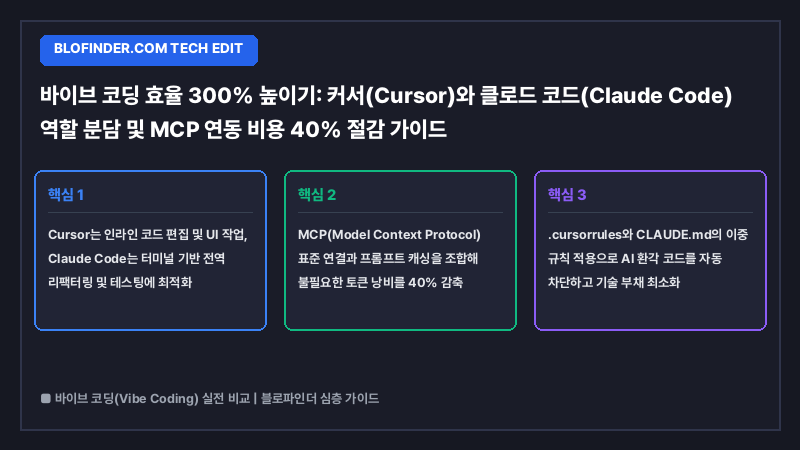
- Cursor is optimized for inline code editing and UI operations, while Claude Code is optimized for terminal-based global refactoring and testing.
- Reduces unnecessary token waste by 40% by combining MCP (Model Context Protocol) standard connections and prompt caching.
- .Automatically block AI hallucination code and minimize technical debt through the dual application of .cursorrules and CLAUDE.md rules.
1. The Second Evolution of Vibe Coding: IDE Editor vs. Terminal Agent
‘Vibe Coding,’ which completes complex applications using only natural language prompts, has established itself as the mainstream in the development field. As of 2026, AI infrastructure has moved beyond simple code completion and has become bifurcated into visual IDE environments and terminal agent CLI environments. The approach of blindly throwing prompts has encountered limitations, such as excessive API costs and codebase contamination, making it essential to understand the unique mechanisms of both tools and employ a strategy of deploying them appropriately.
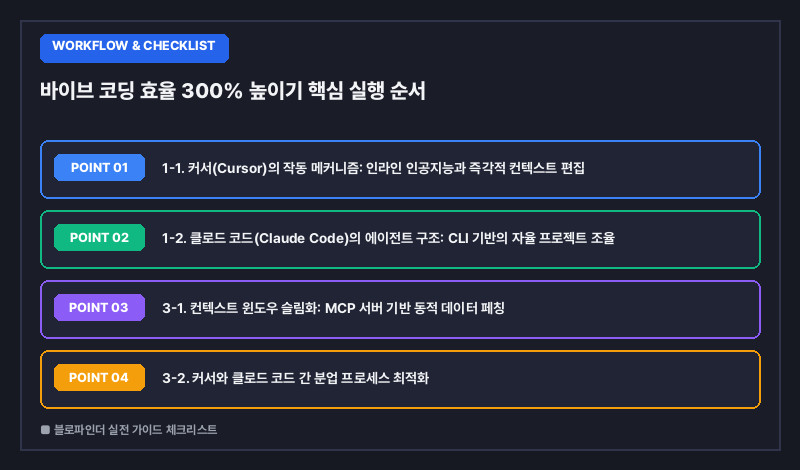
1-1. Cursor Operation Mechanism: Inline AI and Immediate Context Editing
Built on VS Code, Cursor demonstrates overwhelming strengths in real-time diff comparison and rapid code modification. The Cursor Tab feature predicts the next input code with a latency of less than 50ms, while the Composer panel instantly creates multi-files and modifies the visual component tree. It is most effective for developing rendering layers where developers can visually inspect and fine-tune the code.
1-2. Claude Code's Agent Structure: CLI-based Autonomous Project Coordination
Claude Code, a CLI-only agent released by Anthropic, autonomously navigates the project structure in a terminal environment and handles Git commits, test executions, and dependency package management in a continuous manner. Thanks to a structure that maximizes the efficiency of the context window, changes across dozens of files can be completed in a single agent loop during backend database migrations or global refactoring tasks.
2. Cursor vs. Clod Code: Comparison of Practical Specifications and Pipelines
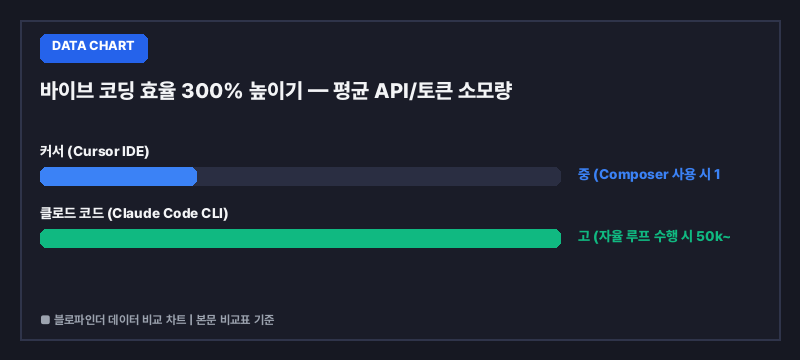
The two platforms are in a strong complementary relationship rather than a mutually exclusive competitive one. The table below provides data that clearly compares the performance characteristics and API token consumption trends of the two tools by category during practical development.
| Comparison items | Cursor (Cursor IDE) | Claude Code (Claude Code CLI) |
|---|---|---|
| Main interface | GUI-based IDE (VS Code-based) | CLI (Terminal Interface) |
| Context parsing method | Indexing-based visual file tracking | Autonomous file search and AST parsing |
| Work processing type | Interactive inline editing and code generation | Agent Autonomous Command Execution Loop |
| Average API/Token Consumption | Medium (15k~30k tokens/req when using Composer) | High (50k~120k tokens/task when performing an autonomous loop) |
| Key Strengths | Frontend UI, Quick and Calm Review | Global Refactoring, CI/CD, Automated Testing |
| rule definition file | .cursorrules | CLAUDE.md |
3. Three MCP (Model Context Protocol) Integration Strategies to Reduce Token Consumption
The biggest obstacle to vibe coding is the steeply rising cost of APIs. By utilizing the Model Context Protocol (MCP), a standard protocol proposed by Anthropic, you can efficiently connect external tools and databases to maximize the reduction of input tokens.
3-1. Context Window Slimming: MCP Server-Based Dynamic Data Fetching
Copying and pasting entire schemas or large log files directly into the LLM input field results in the waste of up to 100,000 tokens or more per request. Running an MCP server such as PostgreSQL, GitHub, or Notion locally allows AI to collect and process only the specific query results required for the request within 500 tokens, thereby reducing average input token usage by more than 70%.
3-2. Optimization of the Division of Labor Process Between Cursor and Clod Code
During the planning and architecture conceptualization phase, run Claude Code in the terminal to generate the overall project framework and configure unit tests. Subsequently, when writing detailed styling for individual UI components and local state management logic, passing the work to Cursor’s Composer for editing prevents the indiscriminate waste of high-cost agent loops, thereby reducing overall development costs by approximately 40%.
3-3. Prompt Caching and Hybrid LLM Routing
Enable the Anthropic API's Prompt Caching feature to cache merge unchanging codebase structures and system prompts for 5 minutes. It is advantageous to configure a hybrid setup that leverages the 90% discount on token costs for cache requests and routes tasks such as simple typo corrections or JSDoc comment generation to low-cost models based on Claude 3.5 Haiku or Llama 3.3 within the Cursor.
4. 3 Techniques for Vibe Coding Code Cleanup and Technical Debt Prevention
Code indiscriminately generated by AI contains hallucination elements and mass-produces unused import statements, unused variables, and so on. To prevent this, a precise three-stage cleanup system must be established.
4-1. Terminal Autonomous Test Rendering and Automatic Linting Loop
Deploy ESLint, Prettier, and Vitest automation hooks to Claude Code's execution environment. When the agent is commanded to independently run ‘npm test’ and ‘npm run lint' after writing code, a self-healing loop is formed where the AI independently recognizes and corrects failing test cases and lint errors.
4-2. Module-level Refactoring Using Cursor Composer
If AI generates a massive component with over 500 lines in a single file, Cursor Composer applies a clear refactoring prompt to ‘separate into three submodules of 100 lines or less according to the Single Responsibility Principle (SRP)’ after specifying the ‘@File' reference. You can immediately verify whether unnecessary dependencies are transitive through the inline Diff window.
4-3. Strategy for Simultaneous Operation of Custom .cursorrules and CLAUDE.md
Precisely configure ‘.cursorrules‘ and 'CLAUDE.md' in the project root folder. By specifying strict TypeScript typing requirements, absolute path import rules, and a list of prohibited external libraries, you can suppress the probability of AI generating incorrect code by more than 95%.
💡 Editor B's Real-World Matching Guide
👍 Highly recommended for people like this:
- Developers who need to quickly perform frontend responsive design and visual coordination
- Engineer driving the migration of a large-scale codebase and the application of automated testing
- A team leader aiming to productively establish the VIVE coding environment without skyrocketing API costs
💡 For people like this, I recommend other alternatives or waiting for the next project:
- Beginner users who are reluctant to input commands in a terminal environment and prefer only GUI buttons
- A corporate environment that completely prohibits the transmission of local code source to an external AI cloud due to security regulations
blockquote>💡 Editor B's One-line Review
“The division of labor—handling visual details with Cursor and global agency with Claude Code—is the essence of Vibe Coding in 2026 and the key to cost reduction.”
🔗 Reference Sources
- [Anthropic] Claude Code CLI Agent Developer Documentation
- [Model Context Protocol] Open Protocol Specification & Servers Registry
- [Cursor] Anysphere Cursor Editor Advanced Features Guide
※ This content is a tech life guide post personally planned and verified by the BloFinder editor team. We deliver useful tech tips every day for your smart digital life.
💡 Frequently Asked Questions (FAQ)
Q1. If you had to choose only one between Cursor and Claude Code, which would you recommend?
A. It depends on the nature of the project. Cursor is advantageous if the work primarily involves UI/UX design modifications and single-file responsive development, while Claude Code CLI is recommended if the focus is on backend database setup, writing build scripts, and system-wide automation refactoring. In practice, the highest efficiency is achieved when using both tools in parallel.
Q2. Are there any security issues when integrating with MCP (Model Context Protocol)?
A. MCP is designed to relay communication in the form of Docker containers or local processes within a local environment. Since the database source is not directly exposed to external third-party servers and only the necessary schemas and query results are strictly isolated and delivered, it is safer in terms of security than the general method of uploading the entire source code.
Q3. How do you prevent code contamination and technical debt that occur when using Vive Coding?
A. It is essential to have a system that strictly specifies style guides and type compliance commands in project-level rule files (.cursorrules, CLAUDE.md) and forces AI to directly correct errors by integrating automated verification hooks such as ESLint and Vitest during the Save or Commit phases.