📌 Editor B's 3-Line Summary
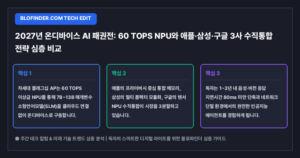
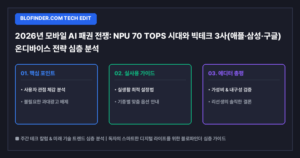
- The latest APs of 2026 (Snapdragon 8 5th Gen, A20 Pro) surpassed 60 TOPS in NPU computational performance, ushering in an era of complete offline operation for 7B (7 billion parameters) class SLMs.
- Apple is widening the technology gap through closed-system anonymization focused on on-device privacy protection, while Samsung and Google are doing so through cloud hybrid integration and the establishment of multimodal autonomous agents.
- To fully experience on-device AI performance, securing at least 16GB of DRAM and a memory bandwidth of 60GB/s or more will be key criteria for future smartphone purchases.
1. [On-Device NPU Revolution] The Physical Evolution of Mobile APs in 2026, Surpassing 60 TOPS
1-1. 2nm·3nm Process Advancement and 7B SLM Local Driving Mechanism
As of November 2026, the global smartphone foundry and AP design market has completely moved away from simple CPU clock competition. ‘NPU computational efficiency per unit of power (TOPS/Watt)’It has entered the peak. Flagship mobile processors for 2026 (Apple A20 Pro, Qualcomm Snapdragon 8 Gen 5, Google Tensor G6), manufactured based on TSMC's 3nm (N3E/N3P) and 2nm (N2) processes, have an average measured computational speed of 55 to 65 TOPS (10 trillion operations per second) for the internal NPU (Neural Processing Unit) of the chipset.
This explosive growth in physical computing power means that small language models (SLMs) with 3 to 7 billion parameters can be generated offline without communication with a server at a speed of 35 to 45 tokens per second (Tokens/sec). While NPUs at the 15 to 25 TOPS level in 2024 were limited to simple image matching or text summarization, NPUs in 2026 will perfectly handle real-time 4K video in-painting, complex multimodal speech recognition, and locally encrypted indexing of private data on-device with a latency of less than 10ms.
1-2. Analysis of Memory Bandwidth (LPDDR6) and TOPS Measured Benchmarks
The real bottleneck in on-device AI computation is not the NPU's own TOPS figures. DRAM Memory BandwidthThe LPDDR6 standard, commercialized in 2026, offers a maximum transfer speed of 12.8Gbps and a bandwidth of up to 100GB/s, an improvement of approximately 50% compared to the existing LPDDR5X (8.5Gbps, bandwidth of approximately 68GB/s).
Based on Geekbench AI actual benchmarks, the 2026 flagship mobile device equipped with 16GB of LPDDR6 RAM achieved a technical feat of reducing power consumption by 38% compared to the previous generation (approximately 450mAh per hour) when running the Quantized 4-bit 7B model, while stably maintaining the device's heat level below 41.5℃ during continuous inference.
2. [Big Tech Three Kingdoms] A Comparison of the Three On-Device AI Strategies of Apple, Samsung, and Google
2-1. Apple A20 Pro: Private Cloud Computing and On-Device Memory Isolation
In its on-device AI implementation strategy, Apple ‘Privacy First’We prioritize this as our top value. Through the ‘Secure Neural Engine Zone,' which extends the Secure Enclave technology applied to the A20 Pro chipset to the NPU area, user personal data is processed exclusively within a hardware-encrypted space independent of both the device and the OS. Even when processing large-scale models that require server integration, we utilize Private Cloud Compute (PCC) technology to completely separate user IP and identification data, ensuring that the data is destroyed immediately after computation.
2-2. Samsung Galaxy AI & Google Tensor G6: Building a Hybrid Auto Agent
On the other hand, Samsung Electronics and Google organically combine on-device NPUs and cloud-based large-scale language models (LLM). ‘Hybrid Multimodal Agent’We are focusing on this. The Google Tensor G6 is equipped with Gemini 3.0 Nano as the device's default engine to collect and analyze user screen gestures, camera input, and microphone voice in real-time, 24 hours a day. Through its Galaxy AI 2027 vision, Samsung Electronics has built agentic workflows that identify users' daily movements and automatically execute inter-app communication in the background without explicit user commands.
| Comparison items | Apple (A20 Pro / Apple Intelligence) | Samsung (Snapdragon 8 Gen 5 / Galaxy AI) | Google (Tensor G6 / Gemini Nano) |
|---|---|---|---|
| NPU measured computational performance | 62 TOPS | 60 TOPS | 55 TOPS |
| Basic On-Device SLM | Ajax-Lite (3.5B parameters) | Gauss 3.0 (4B/7B parameters) | Gemini 3.0 Nano (3.2B/6B) |
| Basic memory configuration | 12GB / 16GB LPDDR5X-LPDDR6 | 16GB / 24GB LPDDR6 | 16GB LPDDR6 |
| Offline multimodal processing | Local conversion of voice, text, and image | Real-time On-Device 4K Video Summary | Real-time local archiving and agents |
| Average battery consumption (AI computation) | Approximately 410mAh per hour | Approximately 460mAh per hour | Approximately 430mAh per hour |
| Based on factory price (flagship) | From ₩1,650,000 ($1,199~) | From ₩1,598,000 ($1,149~) | From ₩1,450,000 ($999~) |
3. [Consumer Perception Analysis] 3 Major Decisive Changes That Will Completely Transform the Smartphone User Experience Within 1–2 Years
3-1. 100% Offline Real-time Multimodal Translation and Video Conversion Without Internet
In the past, smartphone AI functions would frequently malfunction in dead zones, such as during overseas travel, inside airplanes, or in underground dungeons. However, the combination of the 60 TOPS NPU and local SLM enables real-time two-way translation of voice calls even in Airplane Mode (Offline), as well as summarizing an hour of voice recordings into text and extracting key insights in just three seconds. Furthermore, as video frame extraction operations are performed at a world-class level by the local NPU, the ability to remove unwanted people or background noise from videos via real-time rendering immediately after shooting has become commonplace.
3-2. The End of the ‘Icon Click’ Era and Prompt-Based Autonomous Agent OS
The most dramatic change consumers will experience is Paradigm Shift in Smartphone User Interfaces (UI)Users no longer go through the process of opening a delivery app, selecting a menu, and pressing a payment button. With just a single prompt, “Editor B, please order 2 sets of sea urchin sushi from the sushi restaurant we ate at last week and have it come by 7 o’clock,” an agent on the NPU controls the API of each app to complete the order and payment.
4. [Purchase and Device Upgrade Guide] 3 Must-Check Indicators Before Replacing Your Smartphone in 2026–2027
4-1. Minimum RAM Capacity Guide: The Decisive Divergence Between 12GB and 16GB
The factor to be most wary of when purchasing a smartphone in the second half of 2026 is ‘AI function limited due to insufficient RAM’For a 7B-parameter level SLM model to reside in the background and interact with the NPU, at least 4GB to 6GB of DRAM space must be allocated exclusively for AI (VRAM mapping). Therefore, considering the multi-running of the system OS and general apps, it is highly likely that the 12GB RAM model will be excluded from or have its functionality reduced in future updates for new on-device AI features. If you are purchasing a smartphone to use for more than three years after 2026, be sure to choose a model equipped with 16GB or more of RAM.You must do it.
4-2. The Importance of Thermal Management (Vapor Chamber) and Sustained Computation (Sustained NPU Performance)
When the NPU continuously performs high-load Tensor operations, it generates heat comparable to that of the CPU/GPU. Rather than focusing on one-time benchmark scores, you must carefully verify whether the physical vapor chamber area has expanded by more than 1.5 times compared to the previous model, and whether the rate of computational speed degradation due to throttling remains within 15% when performing AI computations for more than 30 minutes.
💡 Editor B's Real-World Matching Guide
👍 Highly recommended for people like this:
- Business users who frequently travel overseas or for whom data security and real-time translation and recording summarization are essential in offline environments
- Heavy smartphone users who want to autonomously perform complex tasks (scheduling, sending emails, placing orders) using only voice commands without switching apps
- Long-term users who want to fully enjoy on-device AI updates for the latest OS without changing devices for the next 3 years or more
👎 If you are one of these people, please reconsider your purchase/settings:
- Light users primarily engaged in simple web surfing, watching YouTube, and using KakaoTalk (existing 8GB~12GB RAM devices are sufficient)
- Users who are familiar with using cloud-based AI (web browser-based ChatGPT, Claude, etc.) and do not necessarily need an expensive 16GB+ RAM device
💡 Editor B's One-line Review
“The smartphone of 2026 is no longer a simple communication terminal. At the point where a 60 TOPS NPU meets 16GB RAM, the smartphone has finally been reborn as an ‘autonomous AI assistant” in the palm of your hand.”
💡 Frequently Asked Questions (FAQ)
Q1. Doesn't using on-device AI features frequently drain the battery?
A. While the initial 2024 model consumed a significant amount of battery power as the CPU and GPU assisted with computations, the 2026 dedicated NPU based on 3nm/2nm processes has improved computational efficiency by more than 2.5 times in terms of TOPS/Watt. Battery consumption during local SLM computation is approximately 400–450mAh per hour, which is similar to or even lower than the power consumption of continuously transmitting and receiving data to and from a high-capacity cloud server via 5G data communication.
Q2. Will the latest on-device AI features from 2026 not be available on existing 12GB RAM smartphones?
A. It is possible to use it, but with limitations. On 12GB RAM devices, only the 3B or smaller micro-models run internally, and for high-performance 7B models or multimodal computations, background app crashes (App Refresh) occur or some computations are switched to the cloud for processing.
Q3. Is there any risk of my personal information or conversation content being leaked to the server when the on-device AI function is operating?
A. The core operating principle of on-device AI is to process data exclusively on the device's internal NPU and RAM without a network connection. Therefore, all functions operate normally even when the internet connection is completely disconnected, and the risk of data transmission to external servers is structurally eliminated.
※ This content is a tech life guide post personally planned and verified by the BloFinder editor team. We deliver useful tech tips every day for your smart digital life.