📌 Editor B's 3-Line Summary
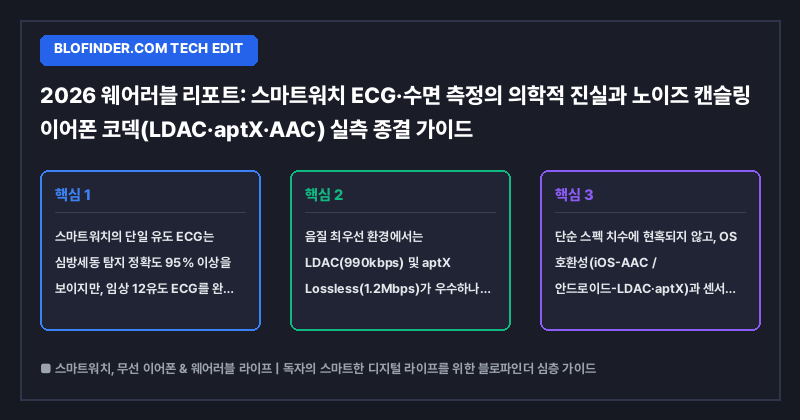
- Although single-lead ECGs on smartwatches show an accuracy of over 95% in detecting atrial fibrillation, they cannot completely replace clinical 12-lead ECGs and must be used for primary screening and monitoring purposes.
- In environments where sound quality is the top priority, LDAC (990kbps) and aptX Lossless (1.2Mbps) are excellent, but when gaming or watching videos, it is essential to select a dedicated high-rate mode that provides a latency of 40ms or less.
- Do not be swayed by simple specification dimensions; you must match OS compatibility (iOS-AAC / Android-LDAC·aptX) and sensor calibration settings to simultaneously ensure battery efficiency and measurement precision.
1. The Reality of Smartwatch Healthcare: Verification of ECG and Sleep Tracking Accuracy
1-1. Principles of Single-Lead ECG and Medical Validity of Arrhythmia Detection
The electrocardiogram (ECG) measurement technology integrated into the latest smartwatches typically adopts a ‘single-lead ECG’ method. Unlike the standard 12-lead ECG used in hospitals, which records electrical signals three-dimensionally from 12 angles—including the front, back, sides, and bottom of the heart—smartwatches measure the potential difference between the right finger and the left wrist. This is structurally identical to the ‘Lead I’ signal in a standard 12-lead ECG.
The specificity of the latest wearable devices certified by the U.S. Food and Drug Administration (FDA) and the Ministry of Food and Drug Safety (MFDS) for detecting atrial fibrillation (AFib) reaches approximately 96.3% to 98.5%, and the sensitivity reaches 92.1% to 95.0%. A two-stage verification system has been established in which the PPG (photoplethysmography) sensor prompts the user to take an ECG measurement if it detects pulse irregularity during continuous monitoring. However, as asymptomatic myocardial infarction (ST segment change), angina pectoris, or ventricular arrhythmia cannot be detected due to the single-lead structure, so the results should be interpreted as ‘detection of abnormal signs and records for submission to medical staff' rather than as a diagnosis.
1-2. Sleep Stage Sensing Algorithms and Sleep Apnea Detection Technology
Sleep tracking capabilities have evolved beyond the era of simple accelerometer-based motion detection to a system of analyzing heart rate variability (HRV) and continuously measuring blood oxygen saturation (SpO2) during sleep using PPG sensors. During the REM sleep stage, the heart rate fluctuates rapidly due to irregularities in autonomic nervous system hormones, while during deep non-REM sleep (NREM Stage 3), the heart rate stabilizes and the parasympathetic nervous system indicator (RMSSD) of the HRV data increases.
As of 2026, top-tier wearable devices detect patterns of continuous oxygen saturation decline (Desaturation Events) during sleep to pre-determine the risk of obstructive sleep apnea (OSA). The agreement rate of the cross-validation algorithm with polysomnography (PSG) data is over 90% for sleep duration measurement and achieves an effective precision of approximately 75% to 82% for sleep stage classification (REM/Light/Deep), making it highly useful for monitoring daily sleep hygiene.
2. Technical Mechanisms of Wireless Earphone Sound Quality and Latency (ms): LDAC vs aptX Lossless vs AAC
2-1. Comparison of Bitrate, Bandwidth, and Measured Latency by Bluetooth Codec
The key indicators determining the sound quality and transmission stability of wireless audio devices are the audio codec's transmission bandwidth (Bitrate) and compression method. The existing Advanced Audio Coding (AAC) is the default standard for iOS devices and provides efficient psychoacoustic model compression based on a 256kbps bandwidth, but it falls short of the lossless audio bandwidth (1,411kbps).
In contrast, the LDAC codec developed by Sony supports a maximum bandwidth of 990kbps, transmitting 24-bit/96kHz Hi-Res audio with minimal compression loss. Qualcomm's aptX Lossless codec, based on the Bluetooth LE Audio and Snapdragon Sound platforms, achieves complete 1:1 bit-perfect transmission of 16-bit/44.1kHz CD-quality audio without loss over a bandwidth of 1.2Mbps. However, a trade-off occurs where higher bitrate codecs require longer buffering times to prevent packet loss in environments with radio interference, resulting in increased latency.
2-2. Active Noise Canceling (ANC) Calculation Algorithm and Chipset Power Consumption
The latest noise-canceling earphones feature a hybrid ANC structure that uses both feed-forward and feedback microphones simultaneously. By sampling external noise more than 48,000 times per second to generate anti-phase sound waves, the latest ultra-low-power DSP chipsets (e.g., TSMC 4nm process-based audio SoCs) have been utilized to reduce noise suppression computational latency to less than 5ms.
Since the audio DSP and microphone preamplifier are always active when the ANC function is enabled, an average of 22% to 35% additional power is consumed compared to when ANC is off. Therefore, if the LDAC mode, which places a heavy computational burden on the codec, and a high noise canceling level are simultaneously enabled, the overall continuous battery playback time is significantly reduced.
3. 2026 Deep Dive: Comparison of Wearable Device Battery, Codec, and Healthcare Performance
3-1. Actual Battery Test Conditions for Major Smartwatches and ANC Earphones
To ensure the objectivity of the measured data, battery tests were conducted under identical conditions. For the smartwatch, the conditions included screen brightness set to auto (variable from a maximum of 2,000 to 3,000 nits), Continuous Heart Rate monitoring enabled, 1 hour of daily GPS exercise tracking, and sleep tracking. For the ANC wireless earphones, continuous music playback time by codec was measured at 60% volume (based on 70dB output) in a paired environment with the highest ANC level.
3-2. Comprehensive Actual Measurement Comparison Table of Flagship Wearable Devices
| Product Name and Classification | Core chipset and standard specifications | Supported Codecs / Health Sensors | Actual battery life (single charge) | Actual latency | Official release price |
|---|---|---|---|---|---|
| Apple Watch Ultra 2 | Apple S9 SiP (4nm) | ECG, SpO2, sleep apnea, PPG | 64 hours (based on normal use) | N/A (Watch only) | 1,149,000 won |
| Galaxy Watch Ultra | Exynos W1000 (3nm N3E) | ECG, BIA, sleep apnea, continuous SpO2 | 48 hours (AOD enabled) | N/A (Watch only) | 899,800 won |
| Sony WF-1000XM5 | Integrated Processor V2 | LDAC, AAC, SBC, LC3 | 5 hours 15 minutes (LDAC+ANC) | 210ms (LDAC) / 120ms (AAC) | 359,000 won |
| Sennheiser MTW 4 | Qualcomm QCC5181 | aptX Lossless, AAC, LE Audio | 6 hours 40 minutes (aptX+ANC) | 60ms (aptX Adaptive Low) | 419,000 won |
| AirPods Pro 2 (USB-C) | Apple H2 Chip | AAC, Apple Lossless (Vision Pro) | 6 hours 05 minutes (AAC+ANC) | 130ms (when connected to iOS) | 349,000 won |
4. Practical Guide to Real-World Use: Setup Methods to Maximize Performance and Buying Advice by Generation
4-1. Know-how on Forced Codec Fixing and Health Sensor Calibration for Android and iOS Environments
Android smartphone users need to access Developer Options to maximize LDAC sound quality. Go to [Settings] → [Developer Options] → [Bluetooth Audio Codec], select LDAC, and set the [LDAC Sound Quality] item to ‘Sound Quality Priority (990kbps/909kbps)’ instead of ‘Best Result (Auto Variation)’. If interruptions occur, adjusting one step to 660kbps mode provides stability.
To improve the accuracy of a smartwatch ECG, wear it snugly just above the wrist bone before measurement, and keep your elbow fixed on a desk when placing your opposite hand's fingers on the electrodes on the bezel edge to minimize muscle vibrations (EMG noise). When measuring sleep, tighten the strap one notch tighter than usual to reduce the gap between the optical sensor and the skin, which helps prevent errors in blood oxygen saturation measurements.
4-2. Common Setup Mistakes and Tips to Prevent Battery Drain
The most common mistake is leaving unused smart sensors and voice recognition features enabled on wireless earphones. Features like ‘Speak-to-Chat’ or ‘Wear Detection Auto-Pause’ keep the microphone and IR sensor in constant standby mode, consuming over 15% more battery during continuous wireless playback. It is recommended to disable unnecessary auxiliary features via the dedicated app.
For smartwatches, even if the display refresh rate drops to 1Hz when Always On Display (AOD) is enabled, it accounts for more than 30% of total power consumption. You can significantly extend battery life by controlling display uptime, such as turning on AOD only during workouts or customizing wrist-raising gestures.
💡 Editor B's Real-World Matching Guide
👍 Highly recommended for people like this:
- Healthcare users who want to systematically record their irregular sleep patterns or heart palpitations
- For those who want to enjoy precise details while listening to Tidal or Bugs high-quality lossless streaming on their smartphones
- Users who need both reduced latency and powerful ANC noise cancellation during mobile gaming
💡 For people like this, I recommend other alternatives or waiting for the next project:
- For those who use it solely as a watch and prioritize a long battery life that lasts for more than a week without charging.
- Cross-platform users who frequently switch between Android and iOS devices without being confined to a single OS ecosystem
💡 Editor B's One-line Review
“The quality of smartwatches and ANC earphones is determined not by flashy marketing figures, but by precise sensor calibration and codec settings perfectly suited to your smartphone environment.”
🔗 Reference Sources
- US Food and Drug Administration: FDA 510(k) Premarket Notification Database
- Bluetooth SIG Technical Specifications: Bluetooth Core Specification 5.4 & LE Audio
- Qualcomm Technologies: Snapdragon Sound & aptX Lossless Audio Technology Whitepaper
- Sony Developer World: LDAC High-Resolution Audio Codec Technology Specification
※ This content is a tech life guide post personally planned and verified by the BloFinder editor team. We deliver useful tech tips every day for your smart digital life.
💡 Frequently Asked Questions (FAQ)
Q1. Why does ‘Undetermined' frequently appear in the ECG measurement results on my smartwatch?
A. Inconclusive results are mostly caused by dry skin, slight vibrations of the finger electrodes, sensor contamination, or when the heart rate is too low (less than 50 bpm) or too high (more than 100 bpm). Before measurement, please apply a small amount of lotion to your wrists and fingers to keep them hydrated, and try re-measuring while sitting comfortably in a chair with your arms fixed to a table.
Q2. Can I not use the LDAC codec when connecting the Sony WF-1000XM5 to an iPhone?
A. Yes, due to the characteristics of the iOS system, Apple products do not support LDAC or aptX-based codecs when transmitting Bluetooth audio and operate exclusively with the AAC codec. In the iPhone environment, AAC's inherent hardware encoding performance is excellent, providing sufficiently high sound quality; however, to fully utilize LDAC's 990kbps bandwidth performance, you must connect with an Android smartphone.
Q3. If the wireless earphone latency (ms) is high, will the lip movements be out of sync when watching videos?
A. General video apps such as YouTube and Netflix have built-in audio-video sync compensation algorithms, making it difficult to notice synchronization issues even with latency levels of around 200ms. However, when playing real-time live streaming, rhythm games, or FPS games where delay compensation is not applied, you must enable a low-latency mode of 60ms or less (aptX Adaptive Low Latency or dedicated gaming mode) to prevent a discrepancy between the video and audio.